

(LEAD) govt-Bessent comments
(LEAD) Seoul says Bessent's comments reflect importance of stable FX in U.S. investment pledge
(ATTN: RECASTS dateline; ADDS BOK chief's comments, latest currency level in last 5 paras)
By Kim Han-joo
SEJONG/SEOUL, Jan. 15 (Yonhap) -- A senior South Korean official said Thursday that U.S. Treasury Secretary Scott Bessent's comments on the recent depreciation of the Korean won reflect Washington's recognition of the importance of stable foreign exchange rates in an investment pledge
During a meeting in Washington with visiting Finance Minister Koo Yun-cheol, Bessent said the recent weakness of the won was not consistent with South Korea's "strong" economic fundamentals, according to earlier news reports. He also stressed that "excess volatility" in the foreign exchange market is undesirable.
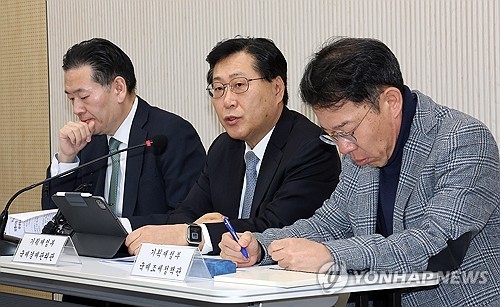
"During the meeting, the two finance ministers shared concerns over the recent steep depreciation of the won and agreed that a stable won is an important factor for bilateral trade and economic cooperation," Choi Ji-young, a senior official at the Ministry of Economy and Finance, told reporters.
In October 2025, Seoul and Washington finalized the details of South Korea's US$350 billion investment pledge, which was made in exchange for lowering U.S. tariffs. Under the agreement, South Korea will invest $200 billion in the U.S. through cash installments capped at $20 billion annually.
Bessent's remarks were released both on his social media account and through the U.S. treasury department.
Some observers said the public release of Bessent's remarks could be interpreted as so-called verbal intervention, as concerns have mounted that the won's weakness may affect South Korean companies' investment plans in the U.S.
Asked whether Seoul had requested such a verbal intervention from Washington, Choi said it would not be appropriate to characterize the situation that way.
Choi also said there is no need at all to consider a currency swap.
"A bilateral currency swap is something that can be considered in the event of a foreign exchange crisis," Choi said, noting that dollar supply is more than sufficient.
Asked about his view on Bessent's comments, Bank of Korea (BOK) Gov. Rhee Chang-yong told a press briefing earlier in Seoul that the remarks reflected well current market conditions.
"Any economist knows that the recent slide of the won toward the 1,480 won level cannot be explained by Korea's economic fundamentals. Bessent is not someone who normally makes such comments, and he would not have said it simply because we asked. He would not do so if it did not reflect the facts," Rhee said.
About three-quarters of the recent currency weakness was due to a strong U.S. dollar, a weak Japanese yen and geopolitical risks, while the remaining quarter stemmed from domestic factors, including a sharp rise in overseas securities investments by local investors, he added.
Citing the weak won and rising concerns over inflation and financial stability, the BOK earlier in the day kept its benchmark interest rate unchanged for a fifth consecutive meeting.
Following the verbal intervention and the outcome of the rate-setting meeting, the currency rose for the first time in 11 trading sessions, reaching 1,469.7 won on Thursday.
(END)
(C) Yonhap News Agency. All Rights Reserved